
The CATIE Center at St. Catherine University invites you to a
CIT Pre-Conference Event
August 12, 2020
St. Catherine University
2004 Randolph Ave | St. Paul, MN 55105
Registration
Registration costs $25/40. (Whatever rate we decide on.) People registered to attend the CIT Conference will receive a coupon code for free registration. To help us with planning, when you register, you will need to select which option you will attend for:
- Morning Session
- Afternoon Session 1
- Afternoon Session 2
Look below descriptions of sessions and options.
Language
All workshops will be presented in ASL unless otherwise noted.
Workshop Options and Descriptions
Workshop Options and Descriptions
Morning Session – Options
- GoReact Session
- 8 am – Noon Presentation
- Noon – 1 pm – Lunch provided by GoReact
- Presentations by the CATIE Center
- 8:15- 9:45 am- What Comes Next?
- 10:00-11:30 am – DI Pathways and Practice
- 11:30 am – 1:00 pm – Lunch on your own
Afternoon Session 1- Options
- 1:00-2:30 pm – Re-Envisioning Inclusion & Transforming Access in Interpreter Preparation and Professional Development
- 1:00-2:30 pm – Verbal Behaviors in Employment Interviews (Presented in combination of English & ASL – Interpretation will be provided)
Afternoon Session 2 – Options
- 2:45-4:15 pm – Behavioral Health and Beyond
- 2:45-4:15 pm – Teaching Research Methods
Click toggles below to learn more about each offering.
GoReact Session
Information coming soon
What Comes Next?
What Comes Next? Transforming Professional Pathways for Novice Interpreters
Doug Bowen-Bailey and Jenny Smith-Hastings
English Abstract
For a long time, the interpreting field has recognized a gap between graduation from an interpreting program and true preparedness for providing qualified services. The US Department of Education, Rehabilitation Services Administration identified this as a critical need in 2015 in its Notice of Final Priorities (NFP). The CATIE Center at St. Catherine University responded to that NFP with a proposal that led to the development of the Graduation to Certification (GTC) project. In this workshop, we focus on the Journey Track component, which provides activities and resources for educators, mentors, recent graduates and students to support the journey of novice interpreters in earning certification and begin their professional careers.
We will provide some background in general about the project and then specifically focus on the resources that the CATIE Center has developed and made freely available through its online Resource Library and GTC Journey track. Resources will include:
- Effective Learning and Practice
- Translation Practice: Strategies for ASL to English
- Assessment Strategies with Marty Taylor
- Preparing to be an Effective Mentee
- Body Language: Talking about Human Anatomy in American Sign Language
- Preparation for the NIC & CDI exams
- Dear White Interpreters: Perspectives from Deaf People of Color
- Returning Home: Strategies for Engagement with Deaf communities and people
- Resources for training mentors and supervisors of novice interpreters
Educational Objectives
- Describe the the Journey Track component of the Graduate to Certification project
- Discuss the school to work gap
- Develop an activity using evidence-based strategies based on the science of successful learning
- Practice an activity using a three-step Vygotskyan approach
- List at least 5 resources for professional development for novice interpreters from the CATIE Center
About the Presenters
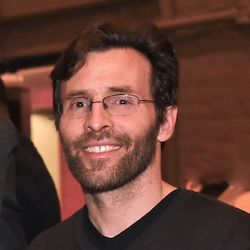 Doug Bowen-Bailey is an instructional designer for the Graduation to Certification program who seeks innovative ways to support recent graduates on their journey to becoming practicing professionals. He has collaborated on many CATIE projects in the past, creating video and online resources, and is excited to now be on staff with the CATIE Center. In addition to working with the CATIE Center, he interprets in the community when he can, provides mentoring services for several northern regions in Minnesota, serves as the webmaster for the Conference of Interpreter Trainers, and is a co-facilitator for Race Awareness Workshops with Community Action Duluth..
Doug lives in Duluth, MN with his partner, Holly. His best thinking often happens while he is on a bicycle, and so is grateful for any chance to be out on the roads and trails on two wheels.
 Jenny Smith-Hastings graduated from Gallaudet University with a degree in interpretation. She has worked with Deaf and Deafblind communities in diverse settings. Jenny co-taught interpreting classes at St. Catherine University and taught ASL classes there as well. Jenny also currently works as a program specialist for the CATIE Center’s Graduation to Certification (GTC) program. Her responsibilities include scheduling pre- and post-assessments, monitoring participant progress, coordinating continuing education documentation for mentors, coaches, and supervisors, maintaining the website, and planning immersion experiences. Jenny also enjoys camping, traveling and spending time with her 3 cats.
DI Pathways and Practice
DI Pathways and Practice: Resources from the Graduation to Certification Deaf Interpreter Journey Track
Jenny Smith-Hastings and Doug Bowen-Bailey
Description
Our field has a growing recognition that transformation requires a return to our roots of having deaf people integrally involved in interpreting – both education and practice. Professional pathways for deaf interpreters often look very different than those for hearing interpreters. Through its Graduation to Certification (GTC) project, the CATIE Center at St. Catherine University is seeking to address this reality. The GTC project identified a number of gaps in resources for deaf interpreters seeking to become certified and is offering them as part of a free, online Deaf Interpreter Journey track. Resources under development include:
- Deliberate Practice for Deaf Interpreters
- Deaf Perspectives on Translation
- Dear White Interpreters: Perspectives of Deaf People of Color
- Interpreting Practice: Consecutive, Simultaneous, Audience Interpreting, Pro-Tactile
- Preparation for the CDI Exam
- Deaf Interpreter Perspectives on Interpreting Models
Additionally, the presentation will point to resources created by other RSA projects and other partners that are available and relevant for deaf interpreters.
Educational Objectives
Successful participants will be able to:
- Compare and contrast pathways to interpreting for deaf and hearing interpreters
- Practice an activity using a three-step Vygotskyan approach
- Develop an activity using evidence-based strategies based on the science of successful learning
- List at least 5 resources for professional development for deaf interpreters from the CATIE Center
- Identify at least three other resources from different partners.
About the Presenters
Jenny Smith-Hastings graduated from Gallaudet University with a degree in interpretation. She has worked with Deaf and Deafblind communities in diverse settings. Jenny co-taught interpreting classes at St. Catherine University and taught ASL classes there as well. Jenny also currently works as a program specialist for the CATIE Center’s Graduation to Certification (GTC) program. Her responsibilities include scheduling pre- and post-assessments, monitoring participant progress, coordinating continuing education documentation for mentors, coaches, and supervisors, maintaining the website, and planning immersion experiences. Jenny also enjoys camping, traveling and spending time with her 3 cats.
Doug Bowen-Bailey is an instructional designer for the Graduation to Certification program who seeks innovative ways to support recent graduates on their journey to becoming practicing professionals. He has collaborated on many CATIE projects in the past, creating video and online resources, and is excited to now be on staff with the CATIE Center. In addition to working with the CATIE Center, he interprets in the community when he can, provides mentoring services for several northern regions in Minnesota, serves as the webmaster for the Conference of Interpreter Trainers, and is a co-facilitator for Race Awareness Workshops with Community Action Duluth..
Doug lives in Duluth, MN with his partner, Holly. His best thinking often happens while he is on a bicycle, and so is grateful for any chance to be out on the roads and trails on two wheels.
Re-Envisioning Inclusion & Transforming Access
Re-Envisioning Inclusion & Transforming Access in Interpreter Preparation and Professional Development
Betsy Winston & Robert G. Lee
Description
Inclusion is both a vision and an action, important to the quality of services consumers can access, and for the preparation of interpreters and educators. Yet, in this era of world-wide digital transformation, and despite years of effort, many organizations, academic institutions, and communities, as well as educators and learners, continue to ignore or marginalize educational approaches that offer access to individuals who do not have the privileged opportunities (of position, wealth, and/or time) to attend on-site experiences. Some examples to be explored in this interactive presentation include: 1. access to networking and professional conferences; 2. digitally published and Open Access materials; and 3. mentoring and teaching technologies.
- Access to networking and professional conferences: Professional conferences cater to those fortunate enough to have the support of funding, employer-paid travel, and paid leave. This continues even though actual funding for these activities is being cut drastically for the few who actually have it. For most interpreters, adjunct interpreting faculty, workshop providers, mentors, and supervisors, such opportunities never actually existed. Many must choose between missing out on professional growth and inclusion that networking opportunities experiences offer, or paying out-of-pocket for registration, travel expenses, and daycare for family, in addition to loss of income. The result is that many are effectively excluded from professional development, advancement, and valuable networking opportunities.
- Digitally published Open Access materials: These include the ability to access research and learning materials freely, or inexpensively via institutional access. Educators, often unaware of these options, require costly texts year after year. While texts are a valuable part of education, our field focuses on interpreting simultaneous interactions. Static texts lack the opportunity to include video and audio examples, demonstrations, and language practice that are so essential to educating interpreters. Digital publishing supports a variety of learning support strategies such as highlighting and annotating text, and viewing video examples. Although these opportunities for knowledge translation and application are available, they are frequently under-implemented in interpreter preparation programs.
- Teaching and mentoring technologies: For some, exclusion is addressed to varying degrees by online learning and engagement opportunities. Unfortunately, many, both teachers and learners, often have limited experience with the many rich opportunities that can truly engage participants with discussions, reflection and knowledge sharing. Moreover, these opportunities are envisioned as a “second-best” option, where the “non-fortunate” might be able to peek in through limited video-streaming, or after the fact, via recorded sessions or written proceedings. While these methods do offer some accessible support, and the option for greater inclusion, there are many richer and more inclusive approaches that we can consider. These include time and space for reflective discussions, and the ability to offer interactive feedback. It is time to make these resources available to all, via avenues that make them accessible for and inclusive of learners, and that support the educators and developers who create them.
This interactive demonstration will offer a variety of strategies, resources, approaches, and options for sharing research and expertise that take true advantage of the many opportunities available today.
Educational Objectives
Participants will:
- identify current professional opportunities that limit access to many students and educators;
- describe perceived limitations to access technologies;
- experience at least one example of more inclusive approaches to texts and learning resources, mentoring and teaching technologies, and participation in professional networking and conferences.
About the Presenters
 Betsy Winston is the Director of the Teaching Interpreting Educators and Mentors (TIEM) Center, a Center focused on excellence and integrity in interpreter and mentor education and research. Her areas of expertise include teaching and research in interpreting, curriculum development, assessment and evaluation, English and ASL discourse analysis, interpreting skills development, educational interpreting, multimedia applications in ASL research and teaching, and teaching at a distance. She holds a Ph.D. in Applied Linguistics from Georgetown University, an M.A. in Linguistics with a focus in American Sign Language from Gallaudet University, and an M.Ed. in Technology & Education from Western Governors University. Dr. Winston has been honored by CIT and RID in 2000 with the Mary Stotler Award, for her contributions to the field of Interpreter Education; in 2016, she received the Outstanding Service to Interpreting award from NAD, as a member of the RID Certification Committee.
 Robert G. Lee has been interpreting, teaching and researching for more than 25 years. He is currently the Course Leader of the MA and Postgraduate Diploma in British Sign Language/English Interpreting and Translation at the University of Central Lancashire (UK). He has previously taught both Interpreting and Linguistics at Northeastern University in Boston as well as having presented workshops and conference papers in North America, South America and Europe. Robert has served on the Boards of the Conference of Interpreter Trainers, the Association of Sign Language Interpreters (UK) and is on the Panel of Experts of the European Forum of Sign Language Interpreters (efsli). He has written extensively on linguistics and interpreting; he co-edited (with Betsy Winston) the RID Press book, Mentorship in Sign Language Interpreting and co-authored (with Peter Llewellyn-Jones) the SLI Press book Redefining the Role of the Community Interpreter: The Concept of Role-space.
Verbal Behaviors in Employment Interviews
Verbal Behaviors in Employment Interviews:
Analyzing Employers’ Assessments of Interview Speech Produced by Interpreters for Deaf Applicants
Erica Alley and Elizabeth Otto
Description
This project addresses three social justice issues. First, deaf job applicants with advanced education struggle to find work. Difficulties in obtaining employment often stem from the pervasive view of deaf people as being disabled and, therefore, incapable of completing job tasks with the same capacity as one who can hear. Second, hearing employers and most members of the hearing population mistakenly believe that ASL-English interpreters create word-for-word reproductions of what ASL users are communicating and therefore assume that any disfluencies or glitches are indicators of the deaf person’s intelligence and capability. Most non-signing listeners are not aware of the cognitive load required to interpret and expect that interpreters are maintaining both content and style in their interpretations (Feyne, 2015). Third, the verbal behaviors favored in an employment interview are not the ones habitually practiced by members outside the dominant majority. As Buzzanell (1999) notes, academic research has identified profiles of applicants who are successful in interviews and applied these profiles to the establishment of recommended communication practices that are likely to result in favorable impressions in the minds of interviewers. The employment interview is a situation designed to strongly favor the characteristics of dominant groups, defined as “white, upper or middle class, heterosexual, able-bodied, Christian, masculine, and privileged” (Buzzanell, 1999, p. 136). As a result, qualified members of marginalized groups—particularly deaf people and women—are rejected by potential employers when they don’t conform to expectations for the “right” way to speak in an interview.
To investigate these challenges, 47 interpreters from across the United States were recorded providing an interpretation for an eight-minute video of ASL interview question answers. The use of video for this study aligns with the current employment trend to conduct initial job interviews via phone, which is considered by employers to reduce cost, time, and potentially bias. For deaf applicants, this results in the incorporation of video relay service (VRS) technology.
The 47 interpretations were analyzed for communication behaviors that may influence the perception of the employer on the hirability of the job candidate. Specifically, hedging, hesitations, lexicon expressing emotion, among other communication behaviors that are disfavored in interviews were analyzed. These communication behaviors are often increased by the cognitive load required to perform interpreting tasks along with lengthy processing time, false starts, and correction techniques. This presentation offers results from the study along with implications for employment opportunities for deaf job applicants as well as potential opportunities to address needs within interpreter education.
Educational Objectives
Participants in this presentation will be able to:
- Identify the communication behaviors that often influence the perceptions of employers on a deaf job applicant’s hirability.
- Evaluate an interpretation for these linguistic features
- Explore methods for application of this knowledge to interpreter education strategies.
About the Presenters
 Erica Alley, Ph.D., is currently the Chair of the ASL and Interpreting Department at St. Catherine University in St. Paul, MN. She has led the development and organization of the Master of Arts in Interpreting Studies and Communication Equity (MAISCE) at St. Catherine University since 2014. Erica holds her doctorate in American Sign Language – English Interpreting Research and Pedagogy from Gallaudet University and has published/presented on the topics of video relay service, video remote interpreting, and the impact of the interpreter on the impression made by deaf applicants during job interviews. Erica holds national certification through the Registry of Interpreters for the Deaf.
 Elizabeth Otto is an Assistant Professor of Communication Studies at St. Catherine University in St. Paul, Minnesota. She hold a Master of Arts in Communication Studies from Northern Illinois University. Her research interests include gendered communication in both interpersonal and organizational contexts and the employment interview as a high-stakes communication interaction. She is inspired by her students to continue to work toward social justice and a better understanding of how communication practices influence opportunity and dignity for traditionally marginalized people.
Behavioral Health Interpreting and Beyond
Behavioral Health Interpreting and Beyond: Resources from the CATIE Center
LaTanya Jones
Description
While interpreting in mental health settings is a specialized skill requiring advanced training, the knowledge and skill needed can benefit any interpreter. Through its Behavioral Health Interpreting (BHI) project, the CATIE Center at St. Catherine University has developed a variety of educational webshops and modules that can be shared with educators for use in teaching and mentoring.
This presentation will introduce participants to resources that can be incorporated into classrooms, workshops, and mentoring experiences. The shorter webshops include:
- Specialized interpreting: Mental Health
- Specialized interpreting: Addiction & Recovery
- Intersectionality in Behavioral Health Interpreting
- Introduction to Deaf/Hearing Teams in Behavioral Health Interpreting
- Specialized interpreting: Domestic Violence and Sexual Violence
- Behavioral Health Interpreting: Trauma-Informed Approach
More in-depth modules include:
- Introduction to Mental Health Interpreting: But I Don’t Do Mental Health!
- Introduction to Addiction and Recovery Interpreting
- Introduction to Domestic Violence and Sexual Violence Interpreting
- Introduction to Psychopharmacology for ASL Interpreters
- “Dear White Interpreters”: Perspectives from Deaf People of Color
Educational Objectives
Successful participants will be able to:
- Identify how interpreting in behavioral settings require specialized skills and knowledge;
- Describe how skills for interpreting in behavioral health settings can apply to other interpreting situations;
- List at least 5 resources from the CATIE Center that can be incorporated into other educational experiences
About the Presenter
 LaTanya Jones is an interpreter with nearly thirteen years professional experience in a plethora of professional and video relay settings, specializing in healthcare interpreting. LaTanya is also an adjunct professor at both the Community College of Philadelphia and Camden County College. A staunch lifelong advocate for education, LaTanya earned an Associate in Applied Science in American Sign Language/English interpreting from CCP, a Bachelor of Business Administration degree from the Fox School of Business at Temple University; continued her studies in ASL linguistics at Gallaudet University; and earned a Master of Science in Management from Rosemont College. Currently, LaTanya is a dual degree graduate student earning a Master of Social Work and a Master in Education in Human Sexuality from Widener University.
In her free time, LaTanya enjoys reading, cooking, and spending time with her family and friends.
Teaching Research Methods
Teaching Research Methods
Jeremy Brunson, Christopher Stone & Cynthia Roy
Presentation Description
In recent years, many of our universities and the CCIE (The Commission on Collegiate Interpreter Education) are now requiring that undergraduate programs teach research to students. This requirement is significant for two reasons: firstly, this is indicative of a transformation in paradigm among interpreter educators, i.e. we are no longer teaching people to interpret but rather encouraging them to think about interpreting as an academic discipline – Interpreting Studies (IS). Secondly, while there are books that address research methods in interpreting, there is no textbook that examines the scope of research methods and methodologies that contribute to the field of Interpreting Studies, and more specifically address the sub-field of Sign Language Interpreting Studies.
While many educators have degrees in specific disciplines, teaching the possible research methodologies and methods of IS can seem an overwhelming task. Faculty find themselves in the position of having to explain and teach research methods and methodologies that they themselves do not know well, and then must explain and teach to students who are training, or have been trained, as practice professionals, but who have not had a thorough grounding in research or research methodologies. This also applies to our growing number of graduate degrees that focus on year-long research projects.
We propose to work together to discuss our understanding of the difference between IS methodologies, methods, and epistemologies. We invite you to read six different research articles to identify research methods, methodologies, and epistemologies. These articles, provided as pre-readings, will represent the disciplines that we believe form the foundation of Interpreting Studies: history, translation, linguistics, sociology, social psychology, and cognitive psychology (see Roy, Brunson, and Stone 2018). Participants will, through group discussions and interactive exercises, discuss methods, methodologies, and epistemologies represented in the articles.
Our aim is to develop an overview for conducting research from different disciplinary perspectives. We will discuss processes, challenges, exemplars, and ways to learn more about these methodologies. Through these discussions, educators can more aptly guide student research preventing haphazard choices or guesses. This will undoubtedly lead to a higher quality of research and further promote Interpreting Studies as an academic discipline.
Learning Objectives
Participants will be able to:
- Explain distinctions between methodology, methods and epistemology in various disciplinary research plans.
- Describe variations in methods, frameworks, and epistemological positions in IS research.
- Assess viability and use of these distinctions by educators.
About the Presenters
 Jeremy L. Brunson holds graduate degrees in Social Justice & Social Inquiry and Sociology from Arizona State University and Syracuse University, respectively. He earned his doctorate at Syracuse University as well as a Certificate of Advanced Studies in Disability Studies. His book, Video Relay Service Interpreters: Intricacies of Sign Language Access, was published by Gallaudet University Press in 2011. His research interests are in the broad area of the sociology of interpreting, and his practice is primarily in the legal arena. He has published and presented about video relay service, educational interpreting, invisible labor deaf people perform, professionalization of sign language interpreting, and ethics. He was awarded The Irving K. Zola Award for Emerging Scholars in Disability Studies in 2009 and was named a Fulbright Specialist in 2017 and spent 6 weeks in Ulaanbaatar, Mongolia helping to establish the country’s first Interpreter Training Program. His most recent publication, with Roy and Stone, is The Academic Foundations of Interpreting Studies and Its Theories, 2018, Gallaudet University Press.
 Christopher Stone earned his PhD from the University of Bristol in 2006. His book, Towards a Deaf Translation Norm was published by Gallaudet University Press in 2009. His research interests are broad, exploring both deaf and hearing translators and interpreters from historical, linguistic, social, pragmatic, pedagogical and institutional perspectives. His interpreting practice is primarily academic conference interpreting. He is an active member of AIIC, an accredited WFD-WASLI IS interpreter and maintains UK (NRCPD) and US (RID) certification.
He has published and presented about Deaf interpreters, educational interpreting, interpreter aptitude (in the Journal of Translation & Interpreting, vol 9) and indexing multimodal resources in translated television news by deaf sight interpreters (in the 2019 Routledge Handbook on Translation and Pragmatics) and within situated learning environments with his colleague Thaïsa Hughes. His most recent edited volume with Lorraine Leeson Interpreting and the politics of recognition (2018) also covers many issues in relation to professional identity. His most recent publication, with Roy and Brunson, is The Academic Foundations of Interpreting Studies and Its Theories, 2018, Gallaudet University Press.
 Cynthia Roy retired as professor in the Department of Interpretation and Translation at Gallaudet University, Washington, DC, where she was also director of the BA program for five years, and director of the PhD program for five years. She earned a masters degree in Linguistics from Gallaudet University and a doctorate in Sociolinguistics from Georgetown University. Her dissertation was published as Interpreting as a Discourse Process by Oxford University Press in 2000. Cynthia is also the series editor of the Interpreter Education Series, and editor of the first three volumes. She has published and presented about discourse analysis, interpreted interactions, and sociolinguistic studies in interpreting. Her most recent publication, with Brunson and Stone, is The Academic Foundations of Interpreting Studies and Its Theories, 2018, Gallaudet University Press.